
How Bright Should a Medical Flashlight Be?
Posted by Raymond on 30th Jan 2026
A Practical Guide for Doctors and Nurses
Choosing the right medical flashlight is more than just picking the brightest option available. For doctors and nurses, the correct brightness level directly affects diagnostic accuracy, patient comfort, and clinical safety. An overly bright flashlight can cause discomfort or glare, while a dim light may obscure critical visual details.
This guide explains how bright a medical flashlight should be, measured in lumens, and how brightness requirements differ across medical applications such as neurological exams, ENT checks, pupil assessments, and emergency care.
What Does “Brightness” Mean in a Medical Flashlight?
Brightness is commonly measured in lumens (lm), which indicates the total amount of visible light emitted by a flashlight.
However, for medical use, brightness alone is not enough. Doctors should also consider:
-
Beam focus and uniformity
-
Color temperature and color rendering accuracy
-
Light stability (no flickering)
-
Adjustable output levels
Still, lumens remain the starting point when selecting a medical flashlight.
Recommended Brightness Levels for Medical Flashlights
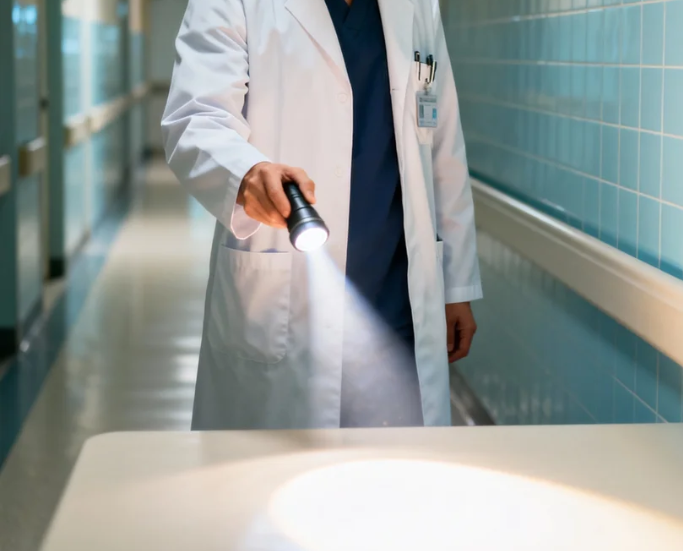
Different medical scenarios require different light intensities. Below is a practical guideline used by many healthcare professionals.
Medical Flashlight Brightness Guide
| Medical Application | Recommended Lumens | Why It Matters |
|---|---|---|
| Pupil examination | 5–15 lumens | Prevents pupil over-constriction and discomfort |
| Neurological exams | 10–30 lumens | Enables accurate pupil response observation |
| ENT examinations | 30–100 lumens | Clear visibility of throat, nasal cavity, and ears |
| General ward rounds | 50–150 lumens | Balanced brightness for routine checks |
| Emergency & trauma care | 150–300 lumens | Strong illumination in uncontrolled environments |
| Surgical prep & inspection | 100–200 lumens | Detailed visibility without harsh glare |
For most doctors and nurses, a medical flashlight with adjustable output from 10 to 200 lumens offers the best versatility.
Why Excessive Brightness Can Be a Problem
More lumens do not always mean better performance in clinical settings.
Overly bright medical flashlights can:
-
Cause patient discomfort or pain
-
Trigger excessive pupil constriction
-
Create glare that hides subtle details
-
Increase eye fatigue for clinicians
This is why professional medical flashlights for doctors often feature low-lumen modes, rather than extreme brightness.
Adjustable Brightness: A Must-Have Feature
A high-quality medical flashlight should allow clinicians to control brightness levels easily.
Benefits of adjustable brightness include:
-
One flashlight for multiple medical tasks
-
Improved patient comfort
-
Better diagnostic accuracy
-
Reduced need for multiple tools
Many modern rechargeable medical flashlights offer multiple output modes, making them ideal for hospitals, clinics, and emergency units.
You can explore professional-grade rechargeable flashlight options suitable for medical use at
https://tank007store.com/
Medical Flashlight vs Tactical Flashlight: Brightness Comparison
| Feature | Medical Flashlight | Tactical Flashlight |
|---|---|---|
| Typical lumens | 10–200 lm | 500–2000+ lm |
| Beam pattern | Soft, focused, even | Intense, long-throw |
| Patient comfort | High | Low |
| Diagnostic suitability | Excellent | Poor |
| Use case | Clinical exams | Law enforcement, outdoor |
This comparison highlights why medical flashlights are specifically designed for controlled brightness rather than maximum output.
Other Factors That Matter as Much as Brightness
1. Color Temperature
Neutral white light (around 4000K–5000K) is preferred in medical environments, as it presents tissue colors more accurately.
2. Beam Quality
A smooth, evenly distributed beam helps doctors identify subtle abnormalities without harsh hotspots.
3. Reliability and Power Source
Rechargeable medical flashlights reduce battery replacement costs and ensure consistent output during long shifts.
Professional rechargeable flashlight solutions for medical environments are available at
https://tank007store.com/
How Doctors and Nurses Should Choose the Right Brightness
When selecting a medical flashlight, ask these questions:
-
Does it support low-lumen modes (under 20 lm) for pupil exams?
-
Can brightness be adjusted quickly with one hand?
-
Is the beam soft enough for close-range inspection?
-
Is the flashlight compact and easy to carry during rounds?
If the answer to all four is yes, the flashlight is likely suitable for daily clinical use.
Final Recommendations
For most doctors and nurses:
-
Ideal brightness range: 10–200 lumens
-
Essential feature: Adjustable brightness modes
-
Avoid: Extremely high-lumen tactical flashlights
A well-designed medical flashlight improves workflow efficiency, enhances diagnostic accuracy, and ensures patient comfort.
To explore professional, compact, and rechargeable flashlight options suitable for medical use, visit:
https://tank007store.com/